

Blog
Cagan Caliskan
Three questions a test answers before its number counts
A check written before the substrate’s priming experiment ran settled the experiment by arithmetic. The substrate is Psyche’s memory-and-activation prototype, and the test had selected 300 primes from a human word-association corpus. Before a single activation was computed, the bare edge weights already ranked the strong associate above the weak one for 296 of them, a separation of about 0.973 on a scale that ends at 1.0. The check asked the full cycle to beat that by 0.20, so a pass would have needed about 1.17 out of a possible 1.0.
Two more checks did the same kind of work on two later experiments. For the fan effect, a
pre-check found that an earlier sweep had already returned the same activation, 0.2433743975,
at fan 1, 2, 4, 8 and 16. For interoception, a body-state signal read from the machine’s own
timers sat near zero on real work, and the band the capture recorded was set by a sleep the
capture itself injected. Each check asked a different question of its test: whether the answer
was already in the input, whether the mechanism was there, and whether the signal moved. Each
was answered before a graded number existed, so none was graded.
Why one check is not enough
Section titled “Why one check is not enough”The reflex repair for a test that cannot be graded is more of something. For the first case it is more primes: the weight-blind pairs the protocol needed turned up for 7 primes in 300, and at that rate roughly 1,300 primes would clear its floor of 30. The fallback ceiling of about 0.027 would not move with the sample at all. For the second case the reflex is a better stimulus set, and for the third a heavier workload. With three ungraded tests on one system, the next reflex is to merge them into one statement, here something like “spreading activation does not produce these effects”.
Each of those readings breaks on the code. The three checks sit at three different points of the pipeline, so they answer different questions, and no single one of them would have caught all three cases.
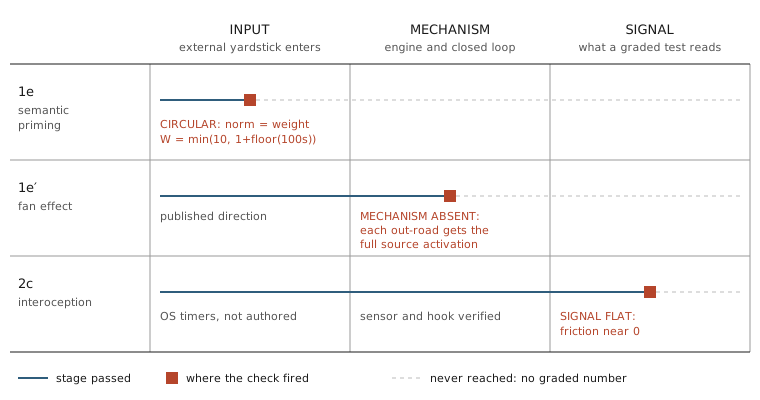
Question one: is the answer already in the input?
Section titled “Question one: is the answer already in the input?”The priming experiment (brick 1e) was designed to grade the direction of semantic priming against the Small World of
Words association norms. The substrate graph was built from the same corpus, and each road’s
weight comes from the same association strength the norms use to call a pair related. From
experiments/swow.py:
def traverse_count_for_strength(strength: float) -> int: """The single fixed monotonic mapping from SWOW association strength to traverse count.""" return min(STRENGTH_CAP, 1 + int(strength * STRENGTH_SCALE))STRENGTH_SCALE is 100 and STRENGTH_CAP is 10. Every corpus row with a positive strength becomes
a road traversed that many times, and traversal count sets a road’s strength in the store. So
“strongly associated” and “heavy edge” are one number seen twice. A result in the predicted
direction, strong associates more active than weak ones at equal distance, could be this map read
straight back out at the target.
The pre-registration saw this and fixed a guard before any
data: the cycle had to separate strong from weak targets where the bare weights could not. That
needs pairs whose strong and weak member land on the same integer weight, a weight-blind stratum.
The selector admits a pair to it only when the integer weights tie, and then only when both
targets also share a decile of in-degree, a coarse control on popularity. From
experiments/priming_1e.py:
high, low = high_low_bands(topo, p) if not high or not low: return None cands: List[Tuple[int, int]] = [] for h in high: wh = w_of(topo, p, h) dh = decile_of(topo.indeg[h], cuts) for l in low: if h == l: continue if w_of(topo, p, l) != wh: # weight-blind: W_gap = 0 continue if decile_of(topo.indeg[l], cuts) != dh: # in-degree-matched: same decile continue cands.append((h, l)) if not cands: return NoneThe blind, seeded selection run consulted only topology and association strength. It found 7 such
primes against a pre-registered floor of 30
(selection output). The in-degree
match dropped none of them, so the count comes from the weight tie alone. Below the floor,
the protocol falls back to a margin over all primes: the cycle’s strong-over-weak separation, as a
rank-biserial r_MA, must exceed the bare weights’ own separation r_W by at least 0.20. The
protocol defines both as twice the fraction of primes with the strong target strictly ahead, minus
one, so a tie counts as no separation. The weights put the strong target strictly ahead for 296 of
300 primes, so r_W = 2 × 296/300 − 1 ≈ 0.973. Neither quantity can exceed 1.0, so the largest
margin any activation pattern could produce is about 0.027. The gate was closed by arithmetic,
before the cycle ran on a single selected pair (D-003).
The obvious repair is more data. More primes could fill the weight-blind stratum, slowly, since the integer ladder rarely gives a prime’s top-decile associate and its 10th-to-25th-percentile associate the same rung. They would not move the fallback: its ceiling is fixed by the fraction of primes the weights already separate, whatever the size of the sample.
Question two: is the mechanism there?
Section titled “Question two: is the mechanism there?”The fan effect (brick 1e′) was the pre-named backup. In people, the more facts are learned about a
concept, the slower any one of them is verified (Anderson, 1974). With a stated bridge from latency
to activation, the prediction was that a target’s activation falls as its source’s out-degree
grows. The account in the ACT-R literature is a fixed source budget divided among its associations.
The transmission loop of src/psyche_activation.py does not
divide by default:
            for road_id, road in roads:                outgoing = node_act                if road.closed:                    frac = closed_transmission(outgoing, road)                    if frac <= 0.0:                        continue  # barrier holds; weak cue blocked                    outgoing = outgoing * frac                    broke_through.append(road_id)  # observable intrusive-recall event
                # two distinct attenuators:                #   edge conductance (road.strength) — property of the connection                #   global distance penalty (decay_per_hop) — property of the spread                transmitted = outgoing * road.strength * decay_per_hop
outgoing = node_act sits inside the loop over out-roads, so every road starts from the source’s
full activation, whatever the number of roads. In a star, a leaf’s activation depends only on its
own road and its own distance, and on nothing about its siblings. The fan sweep in
experiments/fan_effect.py builds a star of equal-strength
roads and reads one leaf as the fan grows; the line is flat to the last digit
(captured output).
The first case’s circularity does not recur here. The star holds edge weight fixed while only fan varies, so the input carries no hidden answer, and what is missing is the mechanism. As the fan-effect specification puts it, priming’s weight-blind stratum was too thin to use, while here the stratum where a bare readback predicts no fan effect is every condition, and the closed loop adds nothing there: the workspace scores a coalition by activation per member, and the broadcast has no out-degree term.
The obvious repair is to add the division. The engine has a default-off overlay that does a version
of it: divisive normalisation, where a road’s drive is scaled by sigma / (sigma + competing) and
competing is the rest of the source’s outgoing conductance. With sigma = 1.0 the same sweep
falls strictly, and the recorded values are in D-008, which also records
the cost: at that sigma, every target on the word-association graph falls below the engine’s
activation floor. That curve is not a result. D-004 holds that a mechanism adopted in order to produce an effect
would not earn it, so the overlay ships with a neutral default identical to the old engine, its own
justification is independent of the fan effect, and no fan-effect claim is made.
Question three: does the signal move?
Section titled “Question three: does the signal move?”The interoception experiment (brick 2c) did not have the first case’s problem, by design. Its yardstick
is the machine’s own timers, which the project cannot author. A body-state number is computed from
them and injected as one global spreading parameter that names no node. The number is defined in
src/psyche_bodysensor.py:
if wall_dt is None or cpu_dt is None: return NEUTRAL_FRICTION if wall_dt < MIN_MEANINGFUL_WALL_DT: return NEUTRAL_FRICTION ratio = cpu_dt / wall_dt friction = 1.0 - ratio if friction < 0.0: return 0.0 if friction > 1.0: return 1.0 return frictionfriction = 1 − cpu_dt / wall_dt is a stall fraction. It rises only when the process is off the
CPU. A cycle of the substrate is single-threaded, held in memory, and does no input, output or
blocking. CPython’s cyclic collector runs in-thread and is counted as CPU time, so a collection
makes a cycle slower without raising friction. On real work the number sits near zero.
The capture written for the graded run,
experiments/exp2c_capture.py, did produce a band, for a
reason visible in its loop:
for i in range(CAPTURE_SAMPLES_REALISTIC): # ONE realistic work interval = real cognitive work (the cycle). The returned # ThoughtResult is intentionally discarded: we measure TIMING, never read its winner. think(workload_store, WORK_UTTERANCES[i % len(WORK_UTTERANCES)]) time.sleep(REALISTIC_YIELD_S) # small cooperative yield (NOT a deliberate stall) samples.append(TelemetrySample(perf=time.perf_counter(), proc=time.process_time()))The yield is 0.5 ms; D-005 records a realistic cycle as about 47 µs of
CPU-bound work. The sleep is the only off-CPU interval, so it sets the level:
1 − 47/(47 + 500) ≈ 0.914. The recorded band was [0.79, 0.93] with a mean of about 0.86, high
and narrow, and its level followed the ratio of sleep to work, with no contention behind it. A description saying otherwise was found false
and corrected in the pre-registration before any graded
number existed.
The obvious repair is a heavier workload. A ratio does not notice: pure CPU work of any size gives
cpu ≈ wall, so ten times the work is ten times the duration at the same friction. The remaining
ways to widen the band are larger sleeps, forced swapping or saturating the cores with rival
processes. Each manufactures the contention it claims to measure, and the protocol forbids all of
them. The sensor, the default-off hook and replay determinism were verified. The check fired on
the signal.
The proof
Section titled “The proof”Each check is pinned by something that runs, and each pin was also run against a deliberately altered scratch copy outside the repository, to see that it can report otherwise.
The circular input
Section titled “The circular input”The selector’s adversarial suite builds
graphs whose correct answer can be derived by hand. One gives a prime whose strong and weak bands
always land on different integer weights and requires that the selector admits no pair; another
requires that the stratum can be a true zero. With the W_gap = 0 check deleted from the
selector, exactly those two checks fail. The 0.973 is not taken on trust either: counting the rows
of the frozen arm (b) pair list
whose w_high exceeds w_low gives 296 of 300, the file’s SHA-256 matches the hash frozen in the
pre-registration, and the ceiling 1 − r_W comes out at about 0.027.
The missing division
Section titled “The missing division”python3 experiments/fan_effect.py reproduces the flat sweep, 0.2433743975 at every fan level,
and its verdict line reports that activation is flat across fan.
The sweep’s determinism test runs that whole script in
fresh interpreters under eight hash seeds and requires byte-identical output. To show the
instrument can see a fan effect when one exists, outgoing = node_act was changed to
outgoing = node_act / len(roads) on a scratch copy of the engine. The same script then reported
activation halving with each doubling of the fan up to 8, then nothing at 16, where the value
falls below the activation floor, and its verdict changed to a match with the human direction. On the real engine, a direct call with normalization_sigma=1.0 reproduced the
D-008 sweep value for value.
The flat signal
Section titled “The flat signal”test_compute_friction_is_the_stall_fraction in
tests/test_psyche_bodysensor.py pins the arithmetic:
cpu == wall gives 0.0, half the CPU gives 0.5, none gives 1.0. One part of the rule against
manufacturing a band is pinned in
experiments/test_exp2c_capture.py: the swept
friction levels are quantiles of the observed range and are never stretched toward the pilot’s
near-saturated extreme. With the sweep widened to run from 0.0 to 0.999, the no-inflation checks
fail. No test forbids an injected wait; that part of the rule is held by the pre-registration, and
the same suite pins the 0.5 ms yield as a constant, so the sleep that made the band is on the
record.
What this does not show
Section titled “What this does not show”- No phenomenon is shown absent. Each statement is that the effect could not be measured under these controls, on this substrate, with this yardstick. Priming was not shown missing; it could not be told apart from a readback of the weights.
- Nothing general follows. This is a finding about one substrate and three yardsticks. It says nothing about spreading activation as a family, about word-association norms elsewhere, or about cognition.
- The mechanisms were not found broken. The missing division was a design choice of the engine, verified and documented. The interoception sensor and its hook passed their verification. Build status and meaning verdict are separate axes, read from the ledger and shown on the substrate status page.
- The timing numbers are machine-specific. The recorded band comes from one machine and one capture. The stall-fraction arithmetic does not depend on it. The statement that garbage collection counts as CPU time rests on the record’s reasoning, and no test measures it.
- The flat fan response is measured on a star. That it holds for other graph shapes rests on reading the transmission code, where convergent activation sums at a target.
- It says nothing about stage 2. Stage 2 shares no model code with the substrate (Origins).
The general lesson
Section titled “The general lesson”Each of the three answers rules out a different repair. A larger sample leaves a ceiling set by the input where it is. A better stimulus set cannot supply a mechanism the engine lacks, and a larger workload does not move a ratio. Reading the three as one result would have pointed at the wrong lever every time. Asking at which point of the pipeline a test can be trusted (input, mechanism or signal) can be answered before any graded data exists.
The second lesson is about timing. All three answers came from checks written before the run: a weight-blind stratum with a floor, a feasibility pre-check, a rule against widening the signal. Any of the three experiments could have been run anyway, and each would have printed a number that looked like a result: a priming separation that might be the weight map read back, a fan curve made by an engine change chosen to make it, a selection shift whose driver was a sleep. The project counts a pre-registered stop caught before a graded run as a first-class result (contributing guide), and these three are why.
Further reading
Section titled “Further reading”- The three walls: the reference page for all three experiments, with the works they cite.
- EXP-1e, the frozen priming pre-registration, and its section 15 outcome.
- The fan-effect specification and its feasibility pre-check.
- EXP-2c, the interoception pre-registration, with its corrected provenance and band-design finding.
DECISIONS.md: D-003, D-004 and D-005 for the three decisions, D-008 and D-009 for the normalisation overlay.- Architecture, section 9, on the body-state sensor, and Methodology.
- The fan-effect characterisation, the earlier exploratory sweep.